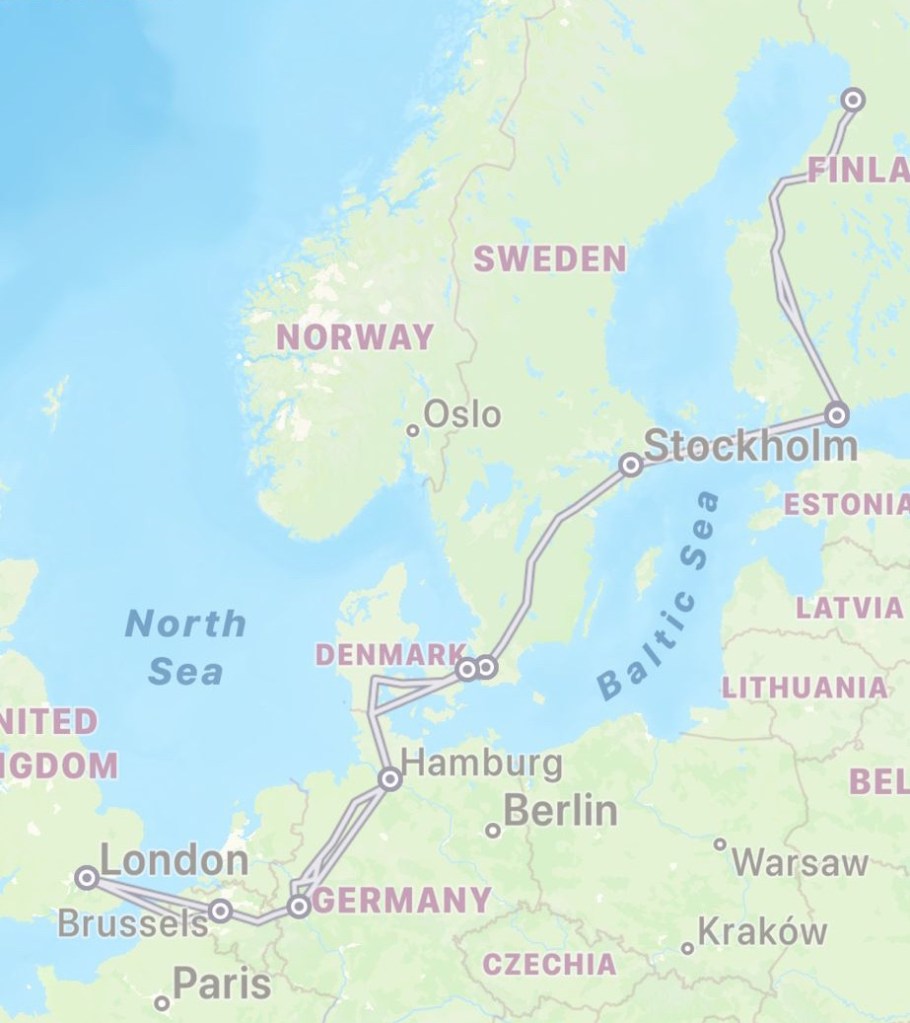
That was an amazing trip to Oulu and back.
Negatives: getting food poisoning and train delays. Germany really struggles to get trains to go on time. Eurostar also had its issues. I did have a 77 minute delay on the sleeper to Stockholm, but that worked in my favour. The sleeper Stockholm was also too hot and the curtains were poor allowing flashes of bright light into the cabin while travelling.
Questionable things: seeing people smoke on train platforms in Germany was strange, and also a bit objectionable. The speed that cars drive at in Hamburg is ridiculously high and not suited to the roads. Also objectionable.
Positives: the trains in Finland, Sweden and Denmark were great, excluding the sleeper. In time. The rolling stock was high quality throughout including Germany. Met some great people. The cycle facilities in Copenhagen and seeing so many cyclists was incredible. We should be doing this in the UK.
Exceeding expectations: The ferries between Stockholm and Helsinki were amazing, good prices, amazing views, great facilities. Finland in winter, incredible, stunning snowy landscapes.
Tips:
Don’t plan to catch the last train of the day.
Don’t make connections too tight.
Travel in your sports gear, make it multi purpose. (Sensibly)
Travel as light as possible.
Plan for the weather.
Don’t arrive late and leave early, it’s exhausting.
Staying for more than one night is more pleasant .
Rucksacks are better than wheelie luggage.
Make use of the late checkouts in hotels.
Carry just in case food and drink.
Make use of sleeper services.
Double check reservations.
Download apps for local public transport. They can be used to get the correct tickets and give directions.
Double check routes given by apps, sometimes they are sending you to the wrong place.
If in doubt, ask a local.
Chat to people on the trains.
Use tracking apps so friends and family can follow your progress. It’s fun and good for safety.
Give someone your itinerary- routes, hotels etc.
Look at and enjoy the landscape, as you travel through.
 Insight